DISTRICT HOUSING FACTORY PLAN TOO RISKY AND COSTLY, THREATENS LOCAL JOBS, WRITES BUSINESS CONSULTANT STUART MORLEY — OPED
MUSKOKA — A District of Muskoka plan to build its own robotic pre-fab public housing factory is drawing considerable debate and opposition as the upper tier local government ends a quick public survey this Friday Aug. 7.
(See story link bottom for full details on it.)
One longtime leading Muskoka business person who has given the idea considerable and thoughtful analysis, is a Gravenhurst consultant Stuart Morley, who opposes it for many reasons. He “urges” councillors reject the plan.
Share his views here if you like — and leave comments below.
He offers six key comments
followed by his recommendations:
“This is my take on the district’s decision to own and operate a factory to address the housing situation, he writes in OPED piece for MuskokaTODAY.com
- 1. Municipal governments are not structured to operate manufacturing businesses effectively. Factory ownership and robotics production involve capital intensity, utilization risk, supply-chain management, quality control, and continuous process improvement. These are disciplines in which private enterprise has clear advantages through competition, specialized expertise, and real financial accountability. Soft budget constraints and political pressures inherent in public ownership consistently undermine performance in similar ventures.
- 2. Private modular capacity already exists and is available for procurement. Established Canadian manufacturers already produce CSA A277-certified modular and multi-residential components. Companies such as NRB Modular Solutions, Guildcrest Homes, ANC Modular, ROC Modular, ATCO Structures, and others regularly supply municipalities and non-profit housing providers. The District can purchase proven products from these firms without assuming ownership risk.
- 3. Scale and utilization risk is high. Efficient factory production requires high and consistent volume. Muskoka’s non-market housing pipeline, while important, is limited relative to the throughput needed to achieve competitive unit costs. Underutilization would erode any projected savings and leave taxpayers subsidizing idle or underperforming capacity.
- 4. Projected cost savings appear optimistic. Industry experience in Canada shows that well-executed modular construction can deliver meaningful schedule advantages and, in many cases, modest cost savings (typically in the 10–20% range when done at scale). Transformative savings are far less common once transportation, site work, soft costs, and overhead are fully accounted for. A newly established municipal operation would face a steeper learning curve than existing private producers.
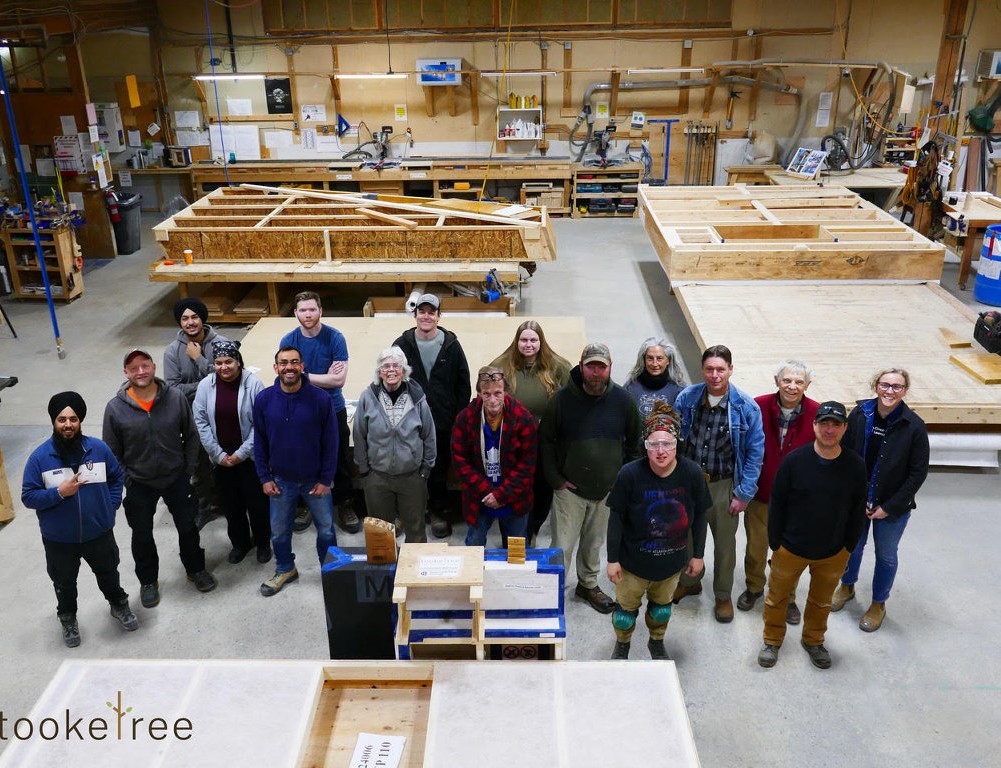
Tooketree already builds prefab homes in Baysville and may be able to expand in to public attainable housing if the District of Muskoka partnered with it instead of constructing its own publicly-funded robotic factory, argues Lois Cooper. PHOTO Tooketree. - 5. Opportunity cost is significant. An investment of up to $17 million represents roughly 16% of the District’s entire annual general tax-supported levy (approximately $106 million in 2026). Even if half is covered by senior government grants, the local share remains a material commitment of public capital and ongoing management attention. Those resources would be better directed toward accelerating land readiness, servicing capacity, capital incentives for private and non-profit builders, and faster approvals—tools that leverage existing market capacity rather than attempting to replace it.
- 6. Local economic impact is uncertain and potentially negative. While the proposal claims support for local jobs and contractors, a District-owned factory risks competing with or displacing private activity with companies like Tooketree Passive Homes. Local contractors will still be required for site work, but the higher-value manufacturing component would be publicly owned and operated. This is not the most efficient way to support the local construction ecosystem.
“I would urge district council to reject the creation
of a District-owned robotics housing factory.”
I would recommend instead that the district:
- Issue competitive procurements or standing offer agreements with established private modular manufacturers;
- Expand capital incentives and partnership programs that leverage private and non-profit delivery capacity;
- Prioritize land, servicing, and approvals reform that remove barriers to both market and non-market housing; and
- Focus public investment where municipal government has clear comparative advantage.
In summary:
The real barriers to non-market housing in Muskoka are municipal rules, approvals delays, and soft costs — not a shortage of factories — so creating a District-owned robotics plant would divert scarce public capital and attention away from the reforms that actually unlock supply.
SEE THIS STORY LINK ON DISTRICT
PROPOSAL AND SURVEY LINK:
DISTRICT WRONG TO PROPOSE ITS OWN ROBOTICS HOUSING FACTORY TO BUILD CHEAP PREBAB HOMES https://muskokatoday.com/2026/07/district-wrong-to-propose-its-own-robotics-housing-factory-to-build-cheap-prebab-homes/
Stuart Morley, MBA, is Gravenhurst based business consultant. His bio says he helped launch Muskoka Founders Circle and the Parry Sound Area Founders Circle , former Executive Director of Parry Sound Muskoka Community Network (PMCN), former President of Gravenhurst Minor Hockey, former director of Gravenhurst Chamber of Commerce, currently a director of Muskoka Lakes Chamber of Commerce, former board member of Muskoka Family Focus and Children’s Place, former board member of Community Living South Muskoka. Husband to Theresa Morley CPA who runs Morley Accounting Services with offices in Barrie and Gravenhurst plus blessed with five grandchildren that are being raised in Muskoka. www.morleyconsulting.com